

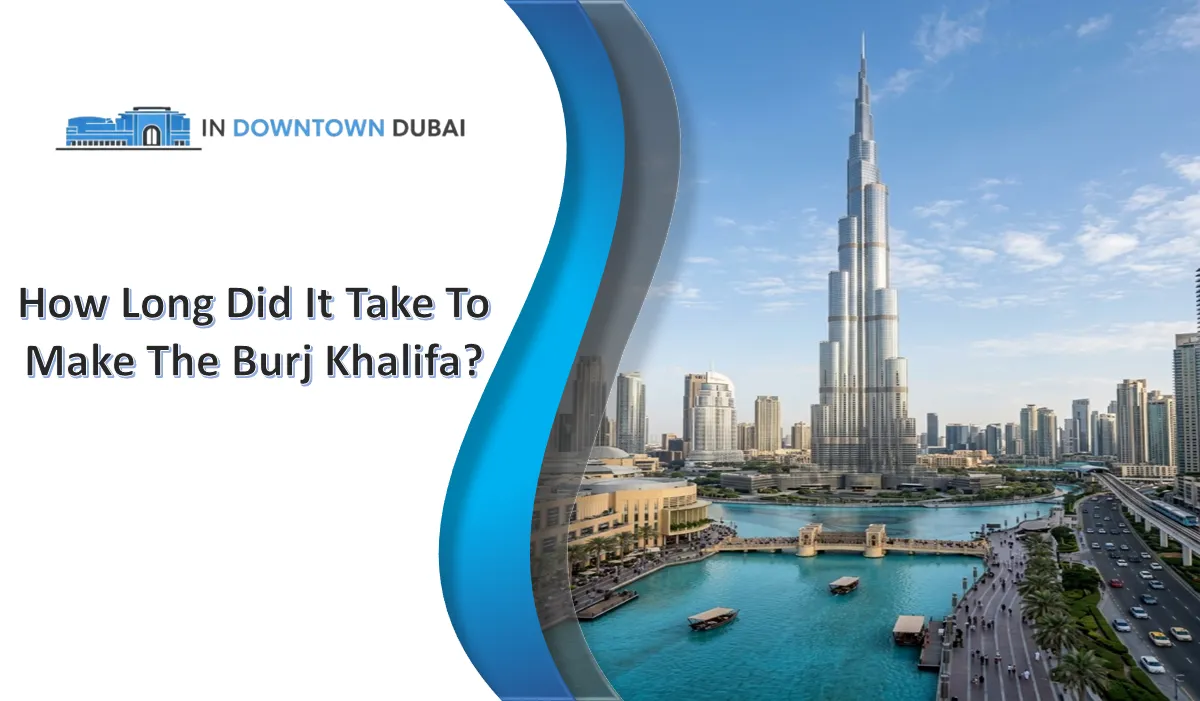
The Burj Khalifa took about six years to build. It was one of the most ambitious construction projects in Dubai and required years of planning, engineering, and large scale construction work.
The tower’s height and unusual design created major challenges for the teams working on the project.
Building such a tall structure required careful work at every stage, from the deep foundation to the upper sections of the tower.
Here is a closer look at how the Burj Khalifa was built and what happened during those six years.
Burj Khalifa Construction Timeline
The Burj Khalifa did not rise to 828 metres in one step. Construction moved through several stages, starting below ground and then moving up through the main structure, exterior cladding, and spire.
Here is the main construction timeline:
| Date | Construction Milestone |
|---|---|
| January 2004 | Excavation started |
| February 2004 | Piling started |
| March 2005 | Superstructure construction started |
| June 2006 | Level 50 reached |
| January 2007 | Level 100 reached |
| July 2007 | Level 141 reached and became the world’s tallest building |
| September 2007 | Level 150 reached |
| April 2008 | Level 160 reached |
| January 2009 | Spire pipe jacking was completed and the tower topped out |
| September 2009 | Exterior cladding was completed |
| January 4, 2010 | Official inauguration |
The timeline shows how quickly the tower gained height after the foundation stage. It reached Level 100 in January 2007 and Level 141 only six months later. By April 2008, the structure had reached Level 160.
How Was The Burj Khalifa Built?
The Burj Khalifa was built in several major stages, from the foundation to the 828 metre structure and its exterior. The main construction work included:
- Foundation: Workers began excavation in January 2004 and built a deep foundation with 192 piles and a 3.7 metre thick concrete mat
- Main structure: The superstructure started in March 2005 and used a Y shaped design with a buttressed core to improve stability
- Concrete work: About 330,000 cubic metres of concrete were used, with concrete pumped to heights of about 601 metres during construction.
- Exterior: The façade used about 103,000 square metres of glass and 15,500 square metres of stainless steel. Cladding was completed in September 2009.
- Spire: The final spire brought the tower to its full height of 828 metres. The tower topped out in January 2009.
These stages took place over several years and required precise planning at every level. The foundation, structural system, exterior, and spire each played a different role in completing the Burj Khali
Who Built The Burj Khalifa?
Emaar Properties developed the Burj Khalifa, while Skidmore, Owings & Merrill, known as SOM, handled the architectural and engineering work. Adrian Smith served as the designer.
The main project roles were:
- Developer: Emaar Properties PJSC
- Architects and engineers: Skidmore, Owings & Merrill
- Designer: Adrian Smith
- Main contractor: Samsung Corporation
- Project and construction manager: Turner International
Samsung Corporation was the main contractor listed for the project. The wider construction involved many specialist companies and teams working across different parts of the project.
How Fast Was The Burj Khalifa Built?
The Burj Khalifa gained height quickly after the main structure began in 2005. The construction milestones show the pace clearly, with major levels reached within relatively short periods.
The main height milestones were:
- Level 50: June 2006
- Level 100: January 2007
- Level 141: July 2007
- Level 150: September 2007
- Level 160: April 2008
- Full structural height: January 2009
The structural construction followed a cycle of roughly one floor every three days during the main building phase.
This pace applied to the repeated structural work and did not mean the complete building, including its exterior and interior, was finished every three days.
Why Did It Take Six Years to Build the Burj Khalifa?
Building an 828 metre tower required several major construction stages. The work began with a deep foundation and then moved into a tall reinforced concrete structure, exterior cladding, and the final spire.
Several factors affected the construction period:
- The foundation required deep piles and a large reinforced concrete mat
- The main structure had to support a tower reaching 828 metres
- Engineers had to account for strong wind forces at great heights
- High performance concrete had to be pumped hundreds of metres above ground
- The exterior required a large quantity of glass, aluminium, and stainless steel
- The spire had to be constructed and raised at the top of the tower
- Exterior work continued after the main structure reached its final height
Wind engineering also played a major role. The Y shaped plan and stepped form helped reduce wind forces, while more than 40 wind tunnel tests examined the tower’s response to wind, heat, and vibration.
What Materials Were Used To Build the Burj Khalifa?
The Burj Khalifa uses large quantities of concrete, reinforced steel, glass, and stainless steel. These materials form the main structure and much of the exterior façade.
The main material figures are:
- Concrete: 330,000 cubic metres
- Reinforced steel: 39,000 tonnes
- Glass: 103,000 square metres
- Stainless steel: 15,500 square metres
These quantities show the scale of the construction operation. The materials had to be moved, installed, and checked as the tower continued to rise.
How Many Workers Built the Burj Khalifa?
More than 12,000 workers were involved at the peak of construction. The project recorded about 22 million man hours in total.
The workforce included people working on foundation construction, concrete, steel reinforcement, structural work, façade installation, engineering, site management, and other specialist tasks.
The large workforce allowed different parts of the project to progress at the same time. Even with thousands of workers involved, the complete construction period still covered about six years from the start of excavation to the official inauguration.
How Much Did It Cost To Build the Burj Khalifa?
The estimated cost of the Burj Khalifa was about US$1.5 billion. This figure refers to the tower itself and should not be confused with the cost of the wider Downtown Dubai development.
The cost covered the tower’s major construction work, including its foundation, structural system, façade, building services, and finishing work.
Conclusion
The Burj Khalifa’s construction was a long, carefully planned process that moved through several stages before the building was ready for use.
Looking at the timeline helps explain why the project required several years rather than being completed in a short period.
The biggest takeaway is that building a skyscraper of this scale involved much more than reaching its final height.
Each stage had to connect with the next, from early site work to structural construction and final preparation.
This timeline gives you a clearer picture of what happened during the years it took to build one of Dubai’s most famous landmarks.
